Hannah’s vow is a pivotal moment in the biblical story. Her vow is found in 1 Samuel 1. The story recounts how Hannah, who is deeply distressed about her inability to have children, goes to the Tabernacle and makes a solemn vow to God. Her story begins with a brief summary of Hannah’s married life before she makes her vow. She was the first of the two wives of Elkanah. Elkanah likely took a second wife because Hannah was unable to bear children, a practice that was common in ancient times. The second, Peninnah, was able to bear him children. Elkanah appears to be a very devout man because the background continues:
Year after year this man went up from his town to worship and sacrifice to the Lord Almighty at Shiloh, where Hophni and Phinehas, the two sons of Eli, were priests of the Lord. Whenever the day came for Elkanah to sacrifice, he would give portions of the meat to his wife Peninnah and to all her sons and daughters. But to Hannah he gave a double portion because he loved her, and the Lord had closed her womb.
Elkanah clearly loved Hannah deeply, despite her inability to have children—a condition that, in ancient times, would have often caused her to be viewed as lacking in value. But Peninnah relished Hannah’s misfortune and provoked and mocked her. This pattern continued year after year, especially during their visits to the Tabernacle. Whenever Hannah went to the house of the Lord, her rival would provoke her until she wept and could not eat. Elkanah, though well-meaning, seemed not to fully grasp the depth of her sorrow when he asked, “Am I not worth more to you than ten sons?”
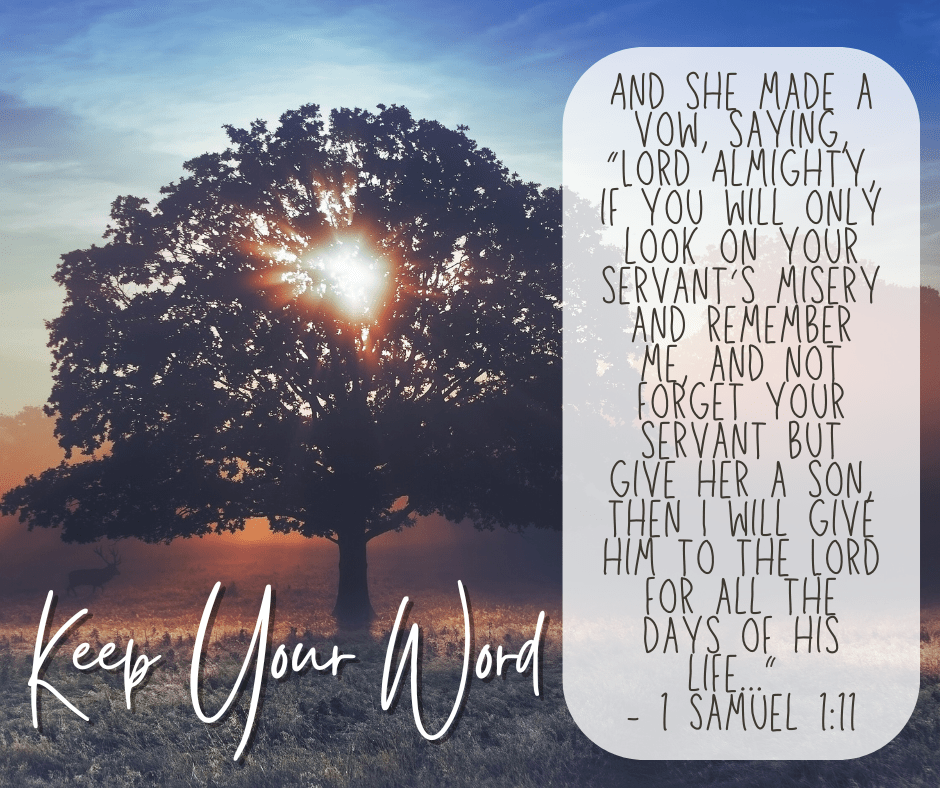
One year after the family had dined, Hannah went to the doorpost of the Tabernacle alone and in her deep anguish, Hannah prayed to the Lord, weeping bitterly. During this prayer Hannah made one of the most iconic vows of the Bible:
And she made a vow, saying, “Lord Almighty, if you will only look on your servant’s misery and remember me, and not forget your servant but give her a son, then I will give him to the Lord for all the days of his life, and no razor will ever be used on his head.”
Eli, the current judge over Israel, saw her crying and praying. At first, he mistook her sorrowful prayer for intoxication because her lips were moving but no sound was coming out. But Hannah told him, “I am a woman who is deeply troubled. I have not been drinking wine or beer; I was pouring out my soul to the Lord. Do not take your servant for a wicked woman; I have been praying here out of my great anguish and grief.” Once Eli realized what was happening, He told her to go in peace and told her “may the God of Israel grant you what you have asked of him.” Hannah simply responded “May your servant find favor in your eyes.” And the account the records then she went her way and ate something, and her face was no longer downcast. The next morning when Elkanah came to be with Hannah the Bible tells us the Lord remembered her. And eventually she bore a son and named him Samuel because the “I asked the Lord for a Son.” When Samuel was old enough, Hannah honored her vow by taking him to the temple and dedicating him to God, giving her only son back to the Lord.
Hannah’s vow highlights themes of faith, sacrifice, and God’s faithfulness in answering prayers. I love the story of Hannah. It especially resonates with me since I am unable to have my own children. Her unwavering devotion to God through years of sorrow, mocking from Peninnah, and a husband who did not fully understand her anguish is truly remarkable. Despite her profound disappointment and deep sorrow, she never gave up on God. In fact, her vow serves as a powerful testament to her faith.
There are two important lessons I’d like to highlight from Hannah’s vow:
🤞 Unlike Jephthah, who made a rash vow driven by emotion in the heat of the moment, Hannah’s vow came after years of sorrow and pain. She made her vow as a heartfelt plea to God, a last resort in her deep anguish. So, our vows are often driven by emotional circumstances but so often we make our emotional vows like Jephthah instead of Hannah.
🤞 Unlike Jephthah, Hannah was very specific in her vow. She fully understood what she was promising and was willing to pay the cost. All she desired was to bear a son for her husband, and if God granted her that blessing, she would willingly give her son back to the Lord. When we make promises to God, we should be very specifc with what we say because it indicates we’ve carefully weighed our words and the consequences of what we are saying.
🤞 Unlike Jephthah, who came to regret his vow because of its cost, Hannah never showed any regret for hers. The Scriptures never suggest that she did. While it is likely that she felt sadness in relinquishing her son to God, she honored her promise and fulfilled it. She visited Samuel yearly and praised God for the blessing of her son (1 Samuel 2). In response to her faithfulness and trust, God rewarded Hannah with more children. Hannah was able to maintain this attitude because, when she made her vow, she meant every word of it.
Hannah’s vow teaches us that our we can make emotional driven vows to God but they should be well thought out. We should mean what we say. We must be willing to pay what we’ve promised. If we follow Hannah’s example then we will not come to regret our vow and God will reward us for our faithfulness. #KeepYourWord
 Adonai's Appeal