For the next few days, let’s take a deep dive into some of the vows made by people in the Bible. The first human-initiated vow to God recorded in Scripture is found in Genesis 28—Jacob’s vow.
Now, to set the stage for the situation that prompts Jacob to make this vow, we must go back briefly in his story. Jacob was the youngest of twins born to Rebekah and Isaac. Their conception was a gift from God, accompanied by a prophecy that the two brothers would be at odds, ultimately leading to the younger surpassing the older. God’s prophecy is evident throughout the story of Esau and Jacob, culminating in Genesis 27, when Jacob and Rebekah deceive Isaac into giving Jacob the blessing intended for Esau, the firstborn. (This follows Jacob’s earlier cunning acquisition of Esau’s birthright from his impulsive brother.) Due to this deception, Jacob has to flee is family and goes on the run from his older brother.
This brings us to Jacob in Genesis 28. Jacob is traveling to his uncle’s home as a refuge and stops to sleep for the night. During his sleep, Jacob has a vision of heaven opening and angels ascending and descending a ladder connecting earth to heaven. At the top of this heavenly ladder stood God, who declared, “I am the Lord, the God of your father Abraham and the God of Isaac.” God then reaffirmed the promise originally made to Abraham, stating it would be fulfilled through Jacob’s line. Jacob jarred awake and declared that the Lord was surely in the place he was resting. The Scripture tells us Jacob was afraid and proclaimed “How awesome is this place! This is none other than the house of God; this is the gate of heaven.”
Due to his deeply profound spiritual experience with God, Jacob makes his vow:
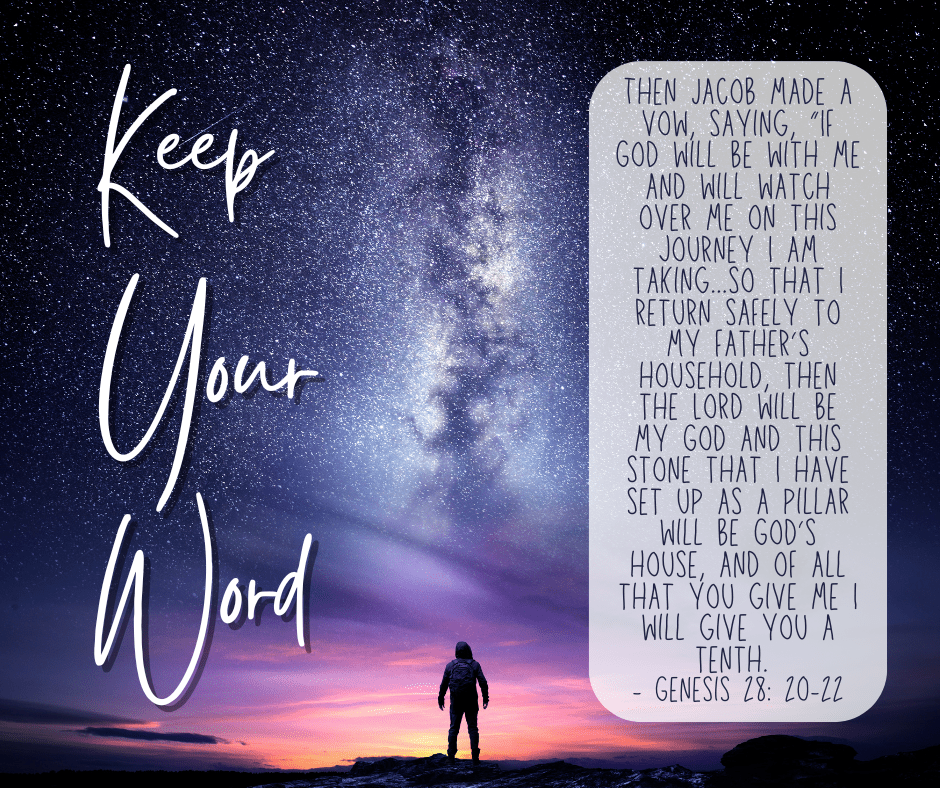
Then Jacob made a vow, saying, “If God will be with me and will watch over me on this journey I am taking and will give me food to eat and clothes to wear so that I return safely to my father’s household, then the Lord will be my God and this stone that I have set up as a pillar will be God’s house, and of all that you give me I will give you a tenth.”
What can we learn from this first vow? There are a few points I’d like us to observe:
🤞 Up to this point, Jacob does not seem deeply invested in the God of his father and grandfather (as evidenced by his previous actions). However, this profound encounter with God radically shifts his perspective, leading him to vow his life to God in response. In fact, up until this vow, God is referred to as the God of Abraham and Isaac. After this vow, He becomes known as the God of Abraham, Isaac, and Jacob.
🤞 Jacob’s vow vividly reflects his humanity. Despite experiencing an extraordinary vision of heaven and encountering God, his vow is conditional: If God is with me, then He will be my God. Jacob needed reassurance from God, even after witnessing that incredible vision. He needed to be certain that God would truly be with him. How often are we just like Jacob? How often do we make similar promises to God, driven by a lack of trust or a need for reassurance in His promises?
🤞 Jacob’s vow acknowledges God’s sovereignty and supremacy by building an altar at the site of the vision—Bethel. This act reflects Jacob’s understanding of God’s role not only in his own life but also in the entire universe, recognizing God as the one to be praised and worshipped. Jacob’s vow is directly linked to reverence and worship of God.
Vows held great significance during Biblical times. They were commonly made when entering into a covenant or seeking divine favor. By making this vow, Jacob demonstrates his reliance on God, his commitment to Him, and his reverence and gratitude toward God.
Jacob kept his vow. He built the altar and followed God for the rest of his days, trusting in God and teaching his sons to do the same. While he was not a perfect man, this vow was undoubtedly deeply meaningful to Jacob. In difficult times—of which there were many—this vow kept him connected to God. He could reflect on the ladder to heaven, his vision of God, and revisit the altar he had built, reminding himself of the vow he made.
Jacob committed his life and trust to God, and in return, God rewarded him for honoring his promise. #KeepYourWord
 Adonai's Appeal