When you make promises, it’s important to truly mean what you say; otherwise, your words lose value. Thoughtlessly made promises are hard to keep because you’ve not really thought about the promise. But, is this how we often make promises? We casually promise to help or attend something without much thought. We set resolutions for the year ahead without considering how we’ll achieve them. We make vows to God to be better without truly reflecting on what that means in our daily lives. Because these promises are made thoughtlessly, they are easily broken. We then justify breaking them by telling ourselves we didn’t plan properly, didn’t truly mean what we said, or didn’t consider the real cost.
Making and keeping promises is deeply important to God. In the Law of Moses, He repeatedly emphasized the significance of promise-making and included consequences for breaking them. For example:
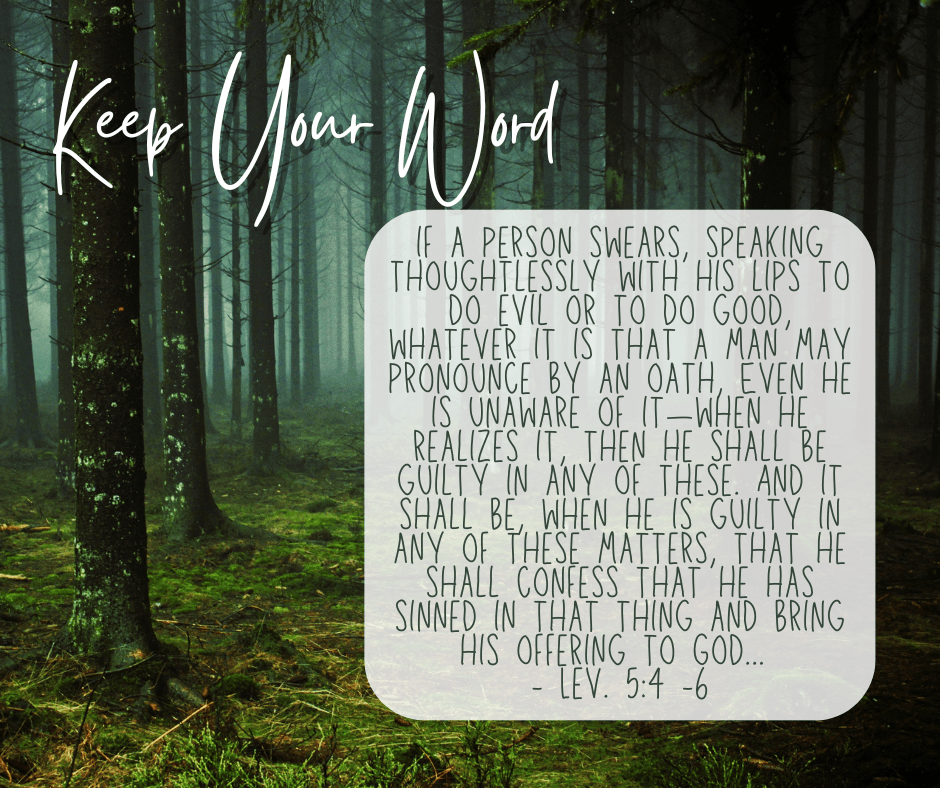
Or if a person swears, speaking thoughtlessly with his lips to do evil or to do good, whatever it is that a man may pronounce by an oath, and even if he is unaware of it—when he realizes it, then he shall be guilty in any of these matters. And it shall be, when he is guilty in any of these matters, that he shall confess that he has sinned in that thing; and he shall bring his trespass offering to the Lord for his sin which he has committed. – Lev. 5: 4 -6
In this part of the law, God identifies making thoughtless promises and failing to keep them as a sin requiring a trespass offering. Regardless of whether you gave your promise careful thought, you made it—whether it was wise or unwise—and you were obligated to keep it. Failing to do so was considered a sin under the Law of Moses. You were required to confess your sin to God and bring him a trespass offering for thoughtlessly making and then breaking a promise.
God’s perspective on making and keeping promises—both to Him and to others—remains unchanged under the New Covenant (as we will explore further). But for today, I want us to mediate on this concept of reckless promise-making.
We often make promises to ourselves, others, and God without much thought. These careless vows are easily broken and quickly rationalized. Yet, to God, a promise is a promise—whether or not we fully consider its implications.
Why does God detest thoughtless promises? Because, ultimately, impulsively made promises are empty and meaningless. When we break them, they become a form of lying because they were made without any intention of us keeping them.
Have you made a thoughtless promise? It’s not too late to turn that careless promise into a genuine commitment. Most often, these promises are made with the best intentions, yet we struggle to follow through. So, if you’ve made a well-intentioned but thoughtless promise, take a moment to reflect on it. How can you achieve it? How can you follow through? Do you need to amend the promise? Do you need to apologize for making an empty promise??
This is especially important when it comes to the promises we make to God. God expects us to keep the promises we’ve made, even when they were made carelessly. Yet, He is full of mercy and understanding. f you’ve made a thoughtless promise, confess it to Him and ask for forgiveness for your impulsive vow. Then, make a new promise—one that reflects thought, consideration, and reverence for God. Don’t think that because you made a hasty promise, God won’t hold you accountable to it. He will so keep your word. #KeepYourWord
 Adonai's Appeal