Psalm 84 is a praise Psalm – one of the most impressive and uplifting Psalms of praise. The authorship is not known. We do the music for the Psalm was created by the sons of Korah who were in charge of making the music for the temple. It is believed the author of this Psalm is the same as Psalm 42 and 43. All three are considered by many scholars to be Psalms of David while he was in exile from Jerusalem. With that context in mind, the Psalm does make sense considering the author is clearly not able to go to the Temple of God and longs for reunion with God in His holy place. (There is ample evidence in the Psalm to support this argument especially in the third stanza.) Yet, since we do not know for sure so we will refer the writer as the Psalmist.
Psalm 84 also features three blessed statements which is a high number for such a short Psalm. Each stanza features one of the statements and each statement builds to the next. They can be taken as isolated truths but are best understood in the context of the entire Psalm. Below are the three statements.
vs. 4 Blessed are those who dwell in Your house; They will still be praising You.
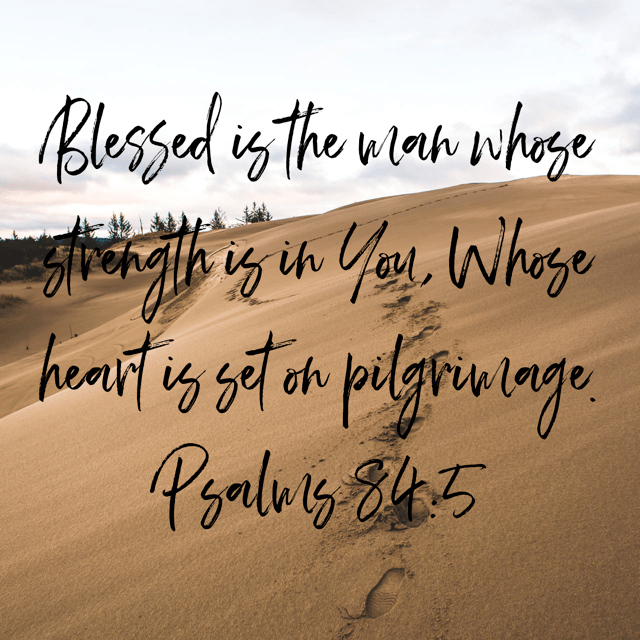
vs. 5 Blessed is the man whose strength is in You, whose heart is set on pilgrimage.
vs. 12 O Lord of Hosts, Blessed is the man who trusts in You!
Now, let’s examine Psalm 84 as a whole.
The Psalmist praises the dwelling place of God. It begins, “How lovely is your Tabernacle, O LORD of Hosts!” It is not a question but a proclamation of the beauty of God’s dwelling place. The writer then exclaims: My soul longs, yes, even faints for the courts of the LORD; My heart and my flesh cry for the LIVING GOD. The author expresses how deeply he longs to be with God in His house. His soul longs and faints for God while his heart and flesh cry out to be the presence of the Living God. The Psalmist makes note that even the sparrows have found a permanent home in the Temple of God. Even Your Altars, O LORD of Hosts provide shelter to the most insignificant of birds. The writer sounds almost envious of that the sparrows and swallows open access to the Temple of God while he cannot access the Temple of God. He concludes the opening verse with the first blessed statement of the Psalm: Blessed are those who dwell in Your house, They will still be praising you. At first glance, this could be read as a singular statement. Those who dwell in the House of God are blessed. But, the Psalmist here is thinking about a particular group. Here commentators suggest that the writer has moved on from envying the birds to envying the priests who live in the temple and praise God all day. He declares how blessed those priests are because they are in the House of the Lord all day every day praising God. This closing to verse is best understood once the reader remembers that rest of the Israelites, the writer included, only got access to the Temple of God on the special feast days according to the Law. Furthermore, the Psalmist’s normal access to the temple has clearly been cut off. So, he is jealous of those who get to go and worship God in His Holy place. The writer longs to be in the Temple of God with the LORD all day praising him like the priests. The stanza declares the blessedness of those who like the sparrows, swallows and the priests have constant access in the House of God so they can praise God.
The second verse opens with the second blessed statement. Blessed is the man who strength is in You, whose heart is set on pilgrimage. The writer moves his focus away from those have unfettered access to the Temple of God and now focuses on those who choose to take strength in God and who set their heart on pilgrimage to the temple. Those who make the pilgrimage to the Temple of God do so through “as they pass through the Valley of Baca.” Some believe the Valley of Baca was a real place and believe it was close to Jerusalem where mulberry trees grow (baca translates into weeping and mulberry tress were called the weeping trees). The valley was prone to flooding in the Spring so those who traversed in would have had to walk through pools of water in the Spring to get to the Temple (vs. 6 & 7) Other scholars also see the Valley of Baca as a symbolic location, the Valley of Weeping or Sorrow. And, those who make the pilgrimage to God will go through sorrows and trials so they must find their strength in God. Regardless, the idea is that the pilgrims traveled a hard road to get to the Temple of God and each eventually made their way to God in Zion. Yet the Psalmist believes the hard trip is worth it because they get to appear before God in Zion. The writer desires to make the trip himself. He wants to be able to make the pilgrimage but cannot.
In the final stanza, the Psalmist explains how badly he wants to be reunited with God. He begins by proclaiming how much he wishes he could be in the court of God even it was just for one day. “For one day in Your courts is better than a thousand” – a thousand days in the courts of men. It is unstated but implied that one day in the Court of Jehovah is better than a thousand days with in courts of kings of earth. The Psalm then makes another comparison. The writer states he would rather be “a doorkeeper in the House of God than dwell in the tents of the wicked. The author, who has already described himself as God’s anointed (vs. 9), would rather be the doorkeeper, a custodian modern vernacular, in God’s temple than dwell (live in leisure) with the ungodly. It is better to be a servant in God’s house than live comfortably with the wicked. The Psalmist declares that the LORD is our sun and shield and recognizes that God gives grace and glory to the righteous. In fact, God withholds nothing from those who walk uprightly (vs. 11). The writer then concludes:
O LORD of hosts,
Blessed is the man who trusts in the YOU!
The Psalmist realizes that even though he cannot personally access the Temple of God how he wants to at that moment – God withholds nothing from those who walk uprightly and trusts in Him. Blessed is the man who trusts in God because God will take care of them. He will serve as their shield and sun. He will provide grace and glory. As long as we trust in God, even if we are not able to be in the House of God, we know God is with us and will take care of us.
There are a multiple of lessons to be learned from Psalm 84. But, I’d like to conclude by focusing solely the second blessed statement: Blessed is the man whose strength is in You, whose heart is set on pilgrimage (vs. 5).
Webster defines pilgrimage as a journey to a place associated with someone or something well known or respected. It is the voyage of the pilgrim. So, then what is a pilgrim? A pilgrim is a person who journeys to a sacred place for religious reasons. So, what does pilgrimage and pilgrim have to do with us? The New Testament is full of reminders that the Lord’s people are not of this world but instead pilgrims making our journey to the lasting city – the New Jerusalem. Jesus himself states My kingdom is not of this world (John 18: 36). Paul tells us that our citizenship is in Heaven (Philippians 3:20). He calls us strangers and aliens in this world but citizens of God’s household (Ephesians 2: 19 – 21). Peter calls us sojourners and exiles in 1 Peter 2:11. The Hebrew writer describes those who died in faith as strangers and pilgrims on this earth (Hebrews 11:13). The Hebrew writer goes one to say in Hebrews 13: 14 For here [earth] we have no lasting city, but we seek the city that is to come.
We cannot become too comfortable here. We are unwanted strangers. Exiles in a strange and ungodly land. We have no lasting city but instead make our pilgrimage to the city that is to come. But that is not an easy road. The Psalm reminds us that we will walk with the valley of weeping and sorrows in order to reach God in Zion. Like the Psalmist, our souls long to be with God and our hearts cry out for God. The only way to make the journey to God is to put our strength and trust in the HIM and to set our heart on pilgrimage. How then do we set our heart? The Scriptures gives us lots of useful strategies and commands of those who have decided to make the trek. Here are just a few:
- Set your mind of things above, not things on this earth (Colossians 3:2).
- Whatever is true, whatever is honorable, whatever is just, whatever is pure, whatever is lovely, whatever is commendable, if there is any excellence, if there is anything worthy of praise, think about these things (Philippians 4:8).
- Do not be conformed to this world, but be transformed by the renewal of your mind, that by testing you may discern what is the will of God, what is good and acceptable and perfect (Romans 12:2).
- Therefore, preparing your minds for action, and being sober-minded, set your hope fully on the grace that will be brought to you at the revelation of Jesus Christ (1 Peter 1:13).
- And those who belong to Christ Jesus have crucified the flesh with its passions and desires (Galatians 5:24).
- And you shall love the Lord your God with all your heart and with all your soul and with all your mind and with all your strength (Mark 12:30).
- Do not lay up for yourselves treasures on earth, where moth and rust destroy and where thieves break in and steal; but lay up for yourselves treasures in heaven, where neither moth nor rust destroys and where thieves do not break in and steal. For where your treasure is, there your heart will be also (Matthew 6: 19 – 21).
The journey to God is not a walk on the beach but a long hard climb up a mountain. It is not for the faint of heart. And without a determined heart focused on reaching the top of Mount Zion, you’ll never finish the climb.
 Adonai's Appeal
You’re teaching me so much about the Psalms.
“By faith he dwelt in the land of promise as in a foreign country, dwelling in tents with Isaac and Jacob, the heirs with him of the same promise; for he waited for the city which has foundations, whose builder and maker is God.”
Hebrews 11:9-10 NKJV
LikeLike